Silence, Please: Why the End of a Signal Matters as Much as Its Beginning
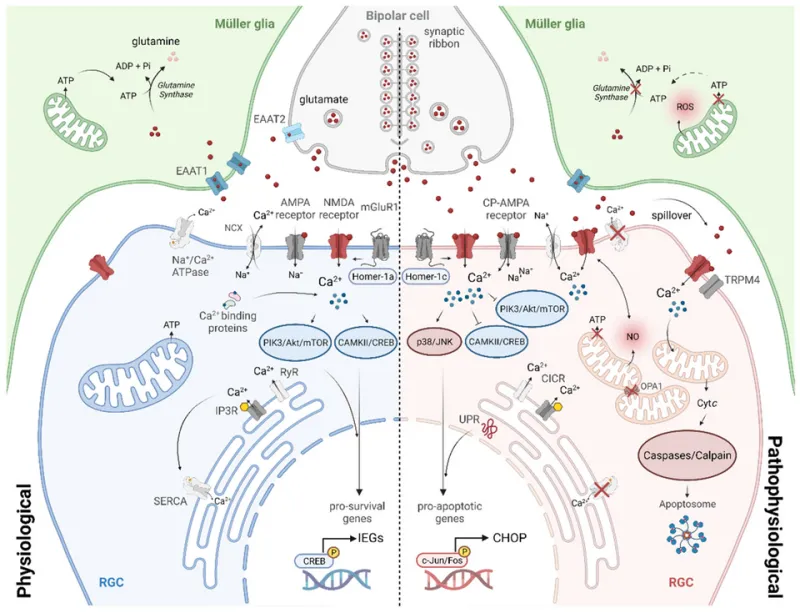
Photo: Boccuni, I.; Fairless, R., CC BY 4.0, via Wikimedia Commons
In the crowded world of the synapse, a message is only useful for as long as it lasts. A burst of glutamate, a puff of acetylcholine, a trickle of dopamine — each must arrive, be heard, and then be swept away with remarkable speed. Biologists sometimes call this 'signal termination', and it is among the most underappreciated processes in molecular physiology. Without it, the nervous system would dissolve into noise: receptors would remain saturated, circuits would lock up, and the exquisite timing that underlies everything from a heartbeat to a thought would collapse.
This article considers the second half of chemical communication — the quiet work of removal — and why two very different stories, one clinical and one military, turn on precisely this mechanism.
A Message With a Half-Life
When a signalling molecule is released, it faces a stark choice: find a receptor, or be destroyed. Chemical messages are not stored; they exist only transiently, in the fluid between cells. Their influence is therefore governed less by how much is released than by how quickly it disappears.
Consider acetylcholine, the neurotransmitter that carries commands from nerve to muscle. At the neuromuscular junction, the enzyme acetylcholinesterase sits waiting in the synaptic cleft, cleaving the molecule into acetate and choline within milliseconds of release. The choline is recycled back into the nerve terminal and rebuilt into fresh transmitter. It is a closed-loop economy of extraordinary efficiency: release, act, dismantle, reassemble.
Amines such as dopamine, serotonin and noradrenaline follow a different route. Rather than being chopped up in the cleft, they are pulled bodily back into the presynaptic neuron through dedicated transporter proteins — the serotonin transporter (SERT), the dopamine transporter (DAT), the noradrenaline transporter (NET). This process, reuptake, clears the signal and recycles the molecule in one motion. What is not recaptured is degraded by enzymes of the monoamine oxidase family, a fact first exploited by pharmacologists in the 1950s with the earliest antidepressant drugs.
The Pharmacology of Interference
If termination is the off-switch, then drugs that jam the off-switch are pharmacologically potent — and their effects depend entirely on which switch is jammed, and where.
Selective serotonin reuptake inhibitors (SSRIs), including fluoxetine, sertraline and citalopram, block SERT. Serotonin lingers in the synapse, its message prolonged rather than amplified. The immediate effect is modest; the therapeutic effect, which takes weeks, appears to involve downstream adaptations in receptor sensitivity and circuit plasticity that scientists are still mapping. The SSRI story is instructive because it shows that prolonging a signal is not the same as strengthening it — the cell's response to a lingering message is itself part of the treatment.
At the opposite pole sits one of the darkest chapters in applied chemistry. Organophosphate nerve agents — including sarin, used in the 2018 attack in Salisbury on Sergei and Yulia Skripal — work by irreversibly inhibiting acetylcholinesterase. Acetylcholine, no longer dismantled, accumulates catastrophically. Muscles contract and never relax; glands flood; seizures follow. The victim of a nerve agent is not poisoned by any foreign substance in the usual sense, but by their own transmitter, unable to fall silent. The antidote, pralidoxime, works by prying the inhibitor off the enzyme — a molecular rescue, if administered in time.
Same principle, opposite intent: both the antidepressant and the nerve agent act on signal termination, one with a therapeutic whisper, the other with a lethal shout.
Termination Beyond the Synapse
The logic extends far beyond neurons. Peptide hormones are clipped apart by circulating proteases. Catecholamines are methylated and oxidised in the liver. Even second messengers inside the cell obey the rule: cyclic AMP is destroyed by phosphodiesterases, which is why drugs such as sildenafil, familiar from a different corner of the pharmacy, produce their effects. In every case, the duration of the message is a regulated variable — as carefully controlled as its magnitude.
Why Silence Is Signal
There is a broader lesson here for students of biology. We tend to narrate signalling as a story of arrival: a ligand binds, a receptor fires, a cascade begins. But a signal is defined by its envelope — its rise and its fall. The fall is not the aftermath of communication; it is communication. A synapse that cannot clear its transmitter cannot encode timing, and timing is what distinguishes a nervous system from a bag of hormones.
For pharmacology, the implications are practical. Many of the most successful drugs of the past century — from SSRIs to phosphodiesterase inhibitors to cholinesterase reactivators — act not on the sending of signals but on their ending. The quiet machinery of termination, long overshadowed by the glamour of receptors, is where a remarkable share of modern medicine does its work.
The next time a signalling pathway is described as a message being delivered, it is worth pausing at the delivery's end. In the synapse, as in a well-run household, the message is only truly finished when the room has been tidied.