Inside the Cell's Post Office: The Nobel Story of Cyclic AMP
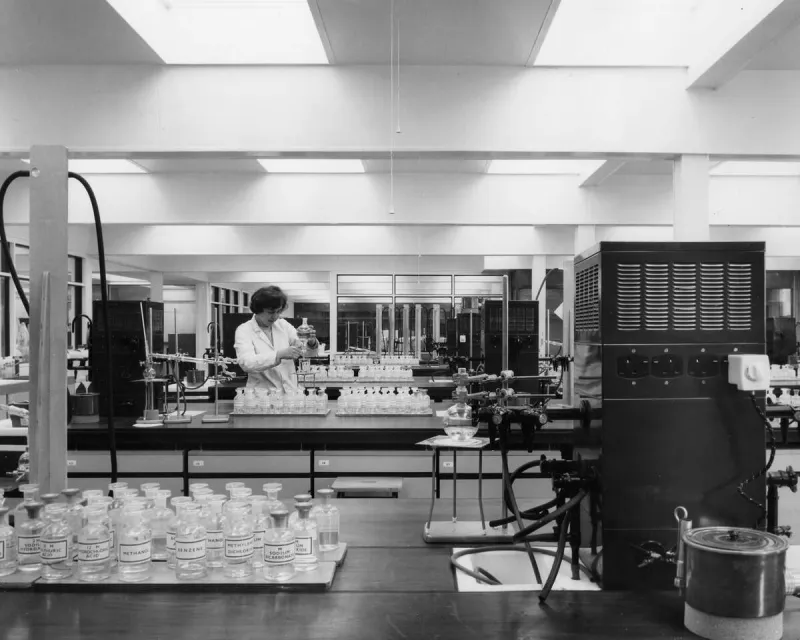
Photo: vintage laboratory biochemistry research 1970s scientific equipment, via www.york.ac.uk
Every so often, a single experiment quietly reorganises an entire discipline. For cell signalling, that moment arrived in the late 1950s, when an American biochemist named Earl Wilbur Sutherland began asking a deceptively simple question: when adrenalin tells a liver cell to release glucose, what actually happens inside the cell?
The Problem of the Locked Door
The biochemistry of the day understood hormones as messengers circulating in the blood, delivering instructions to target tissues. What remained murky was the mechanism of delivery. The prevailing assumption was that hormones themselves entered the cell and got to work directly, rather like a letter carrier climbing through the window to read the post aloud.
Sutherland, working first at Washington University and later at Vanderbilt, found evidence that complicated this picture. When he broke liver cells open and separated the debris, the hormone's activity did not follow the hormone. Instead, a heat-stable, low-molecular-weight substance appeared in the cell's interior wherever adrenalin or glucagon had acted. The messenger, it seemed, never crossed the door. It knocked, and something inside carried the message onward.
Naming the Courier
That something turned out to be cyclic adenosine 3',5'-monophosphate — cyclic AMP, or cAMP — a ring-shaped derivative of ATP assembled by an enzyme embedded in the cell membrane. Sutherland and his colleague Theodore Rall demonstrated that cAMP could reproduce the effects of the hormone in broken cell preparations, and that the membrane-bound enzyme adenylate cyclase manufactured it in response to hormone binding.
The conceptual leap was profound. Sutherland proposed a two-step architecture: the hormone is the 'first messenger', operating outside the cell, while cAMP acts as a 'second messenger' relaying and amplifying the instruction within. One molecule of adrenalin bound at the surface could generate a cascade of cAMP, which in turn activated protein kinase A and redirected swathes of cellular metabolism. Amplification, not mere transmission, was the point.
The 1971 Nobel Prize in Physiology or Medicine recognised this framework, and with it the birth of molecular pharmacology as we now practise it.
From Bench Curiosity to British Medicine Cabinet
Why should a student in Manchester or a pharmacist in Cardiff care about a molecule characterised in Nashville over seventy years ago? Because the second messenger model turned out to be the operating system for an extraordinary range of therapeutics.
Consider the salbutamol inhaler carried by millions of Britons with asthma. It works by binding beta-2 adrenergic receptors on airway smooth muscle, provoking adenylate cyclase to raise intracellular cAMP, which relaxes the muscle. Consider, too, the PDE5 inhibitors prescribed for erectile dysfunction and pulmonary hypertension: they work by blocking the enzyme that degrades cyclic nucleotides, thereby prolonging the messenger's working life.
Sutherland's framework also anticipated the receptor biology that followed. The G-protein-coupled receptors that feed adenylate cyclase became, in time, the most heavily exploited drug target family in the human genome — a fact reflected in the Nobel recognition later awarded to Robert Lefkowitz and Brian Kobilka in 2012.
The British Contribution
The second messenger story has deep roots on this side of the Atlantic. British laboratories were central to working out how cAMP exerts its effects, particularly through the phosphorylation cascades characterised by Philip Cohen's group in Dundee, whose work on protein kinases clarified how second messengers are translated into coordinated cellular responses. UK groups have likewise contributed substantially to understanding phosphodiesterases, the enzymes that switch the signal off — a reminder that termination is as physiologically important as initiation.
That tradition continues. British pharmacology departments remain active in exploiting cAMP compartmentalisation: we now know the messenger is not uniformly distributed but organised in microdomains near the membrane, a subtlety with real consequences for drug selectivity. Designing molecules that act on specific cAMP pools, rather than flooding the cell, is an active frontier.
A Lesson That Outlived Its Discoverer
Sutherland died in 1974, only three years after Stockholm. The principle he established — that signals at the cell surface are converted into portable intracellular currency — now extends far beyond cAMP, encompassing calcium ions, cyclic GMP, inositol trisphosphate and lipid messengers. Each follows the same logic: reception, transduction, amplification, termination.
For students encountering cell signalling for the first time, the history offers a methodological lesson as much as a factual one. Sutherland succeeded by refusing to assume that the message and the messenger were the same thing. In pharmacology, as in the post office, it pays to ask who is actually carrying the letter.