Ethanol at the Synapse: The Molecular Story Behind Every Round Bought
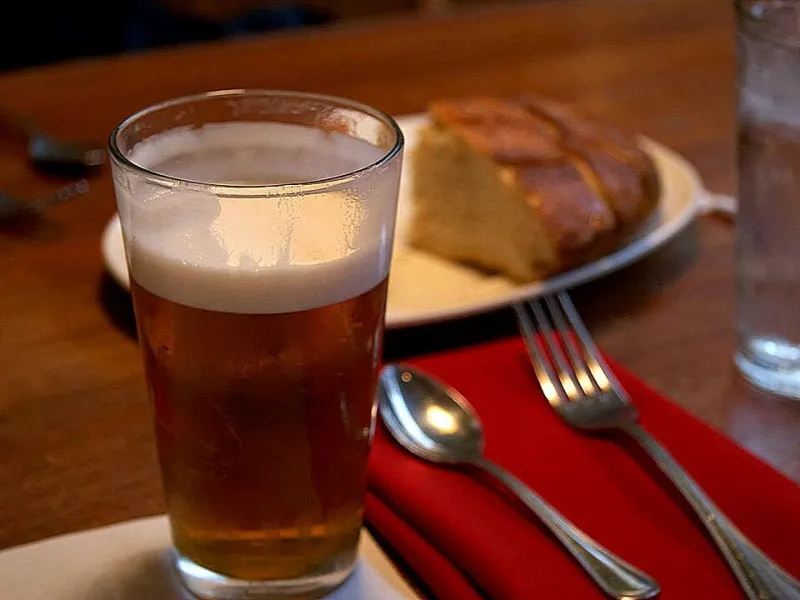
Photo: Jon Sullivan, Public domain, via Wikimedia Commons
Ethanol is a small, unremarkable molecule — two carbons, an oxygen, a hydroxyl group. Yet it is arguably the most widely consumed psychoactive drug in the United Kingdom, available at every supermarket and village pub, and its effects on the brain are entirely a story of synaptic signalling. Understanding that story explains not only why the third pint feels different from the first, but why the following morning can be so miserable.
The Two Pedals of the Brain
To appreciate alcohol's effects, picture the brain's signalling as a car with an accelerator and a brake. The accelerator is glutamate, the principal excitatory neurotransmitter, which urges neurons to fire. The brake is GABA (gamma-aminobutyric acid), the principal inhibitory transmitter, which tells them to quieten down. Healthy brain function depends on the balance between the two.
Ethanol interferes with both pedals, and it pushes them in the same direction: it enhances GABA signalling and suppresses glutamate signalling. At GABA-A receptors, alcohol prolongs the inhibitory current, so chloride channels stay open longer and neurons are dampened more strongly. Meanwhile, ethanol inhibits the NMDA subtype of glutamate receptor, blunting excitation. The result is a brain with the brakes applied and the accelerator released — hence the slurred speech, slowed reactions and relaxed inhibition of an evening in the pub.
Why the Effects Change Over an Evening
Ethanol's actions are not fixed; the brain adapts. Faced with sustained enhancement of inhibition, neurons compensate by reducing GABA receptor sensitivity and, in parallel, upregulating NMDA receptors to restore some excitatory tone. This is tolerance at the molecular level: the same pint produces a smaller effect because the synapse has recalibrated.
Tolerance also explains escalating consumption. A drinker chasing the relaxed feeling of their first drink must increasingly fight their own compensatory adjustments to get there.
The Morning After: A Synapse Out of Balance
Herein lies the hangover. When ethanol finally clears, the compensatory changes do not vanish instantly. The brain is left with weakened inhibition and a surplus of hypersensitive NMDA receptors — a state of excitatory rebound. The tremor, restlessness, early waking and heightened sensitivity to light and noise of the classic hangover reflect a nervous system temporarily tipped towards over-excitation.
Add the contributions of vasopressin suppression (leading to dehydration), disrupted sleep architecture, acetaldehyde exposure and inflammatory signalling, and the 'morning after' emerges not as a moral reckoning but as predictable pharmacology: the downstream consequence of the brain recalibrating around a drug that is no longer there.
Harm, Evidence and the Current Debate
None of this is a lecture; it is chemistry. But the chemistry has policy relevance. Alcohol harm has returned to the fore of UK public health debate, with the Chief Medical Officers' guidance recommending no more than 14 units per week, spread across several days, and alcohol-specific deaths in the UK reaching record levels in recent years. Debates over minimum unit pricing — introduced in Scotland in 2018 and Wales in 2020 — and over clearer labelling rest on the same underlying biology: ethanol acts on the very synaptic systems that mediate dependence, which is why patterns of use can shift from social to compulsive.
For students, the pharmacology offers a neat case study in how a drug's acute effects, tolerance and withdrawal are not separate phenomena but stages of a single adaptive conversation between molecule and synapse. For everyone else, it is worth knowing what is actually happening in the half-hour after the last orders bell: a brain quietly renegotiating its own chemical balance.
The Takeaway
Ethanol does not simply 'depress' the brain in a vague sense. It tilts the fundamental excitatory–inhibitory balance of synaptic signalling towards inhibition, provokes compensatory changes that produce tolerance, and leaves behind a rebound excitation we experience as the hangover. The pub, in molecular terms, is a pharmacology laboratory — and every round is an experiment the brain must later correct.