One Hormone, Many Directions: The Auxin Story Behind Every Leaning Windowsill Plant
Order a gin and tonic in any pub garden from Cornwall to the Cairngorms and you will find yourself surrounded by plants quietly solving a physics problem. The geraniums on the bar top, the trailing lobelia in hanging baskets, the unfortunate fuchsia that has spent the week wedged against a brick wall — all of them are lopsided, and all of them are lopsided in the same direction: towards the light.
This bending, familiar to anyone who has ever turned a houseplant on a windowsill, is not a mechanical accident. It is a coordinated cellular response, orchestrated by a signalling pathway so economical that biologists still marvel at it. One molecule, moved from one side of a shoot to the other, is enough to change the shape of an entire plant.
Darwin's Grass Seedlings
The story begins, appropriately for a British subject, in an English garden. In the 1880s, Charles Darwin and his son Francis were experimenting with grass seedlings at their home in Kent. They noticed that seedlings bent towards light only if the very tip of the shoot was intact. Cover the tip with an opaque cap, and the seedling grew straight upwards, oblivious to the sun.
The Darwins concluded that some influence must travel from the tip downwards, carrying instructions about the direction of light. Later work by Peter Boysen-Jensen and Frits Went in the 1920s confirmed that the influence was chemical — it could even diffuse into a block of agar and, when placed asymmetrically on a decapitated seedling, cause the same characteristic bend.
The chemical was named auxin, and it remains the archetype of a plant signalling molecule.
The Signal Is a Gradient
What makes auxin remarkable is that the message is not simply its presence or absence, but its distribution. In a young shoot, auxin is synthesised at the tip and transported downwards. Crucially, when light strikes the shoot unevenly, auxin is actively shuttled towards the shaded side.
The result is a concentration gradient across the shoot: less auxin on the lit side, more on the shaded side. Auxin's cellular effect is to promote elongation — it loosens the cell wall, allowing cells to stretch. So the shaded side grows faster than the lit side, and the shoot curves towards the light.
It is worth pausing on the elegance here. There is no muscle, no hinge, no moving part. The plant bends because one side of itself simply grows more than the other. The signal is spatial, and the response is architectural.
The Transporters That Make It Work
None of this would be possible without molecular machinery capable of establishing the gradient. That machinery is a family of proteins called PIN transporters, named after the pin-formed mutant Arabidopsis plants that first revealed their importance.
PIN proteins sit in the cell membrane and pump auxin out of cells in a specific direction. Their real trick is polarity: within any given cell, PINs are positioned on only one face of the membrane, so auxin flows consistently from cell to cell, like water through a series of one-way valves.
When light is detected by photoreceptor proteins called phototropins at the shoot tip, a phosphorylation cascade alters where PINs sit. More auxin is directed to the shaded flank, and the gradient forms within minutes. On a late summer evening, as the sun drops behind the pub wall, the geraniums on the bar top are already repositioning their transporters for tomorrow's growth.
One Pathway, Many Outcomes
Phototropism is only the most visible of auxin's duties. The same molecule, acting through essentially the same signalling logic, governs apical dominance — the suppression of side shoots by a growing tip, which is why pruning a hedge makes it bushier. It guides roots downwards, prompts fruit development, and coordinates the plant's response to gravity.
This is the deeper lesson of auxin for students of cell signalling. Evolution frequently economises: rather than inventing a new signalling system for every developmental decision, plants reuse a single hormonal pathway, varying only the context in which it operates — which tissue, which transporters, which downstream genes. The specificity lies not in the signal itself but in how and where it is delivered.
The same principle appears throughout biology. In animals, a handful of morphogens pattern entire embryos, and a limited set of second messengers underpin an enormous diversity of cellular responses. Understanding auxin means understanding that in signalling, geography is often destiny.
Why the Bend Matters
For a plant, phototropism is not decorative. Light is energy, and energy is survival. A seedling that emerges in the shade of a wall — or beneath the crowded canopy of a hedgerow — must find the light quickly or exhaust its reserves. The bending response is a matter of life and death, executed without a nervous system, using nothing more than a chemical gradient and a set of directional pumps.
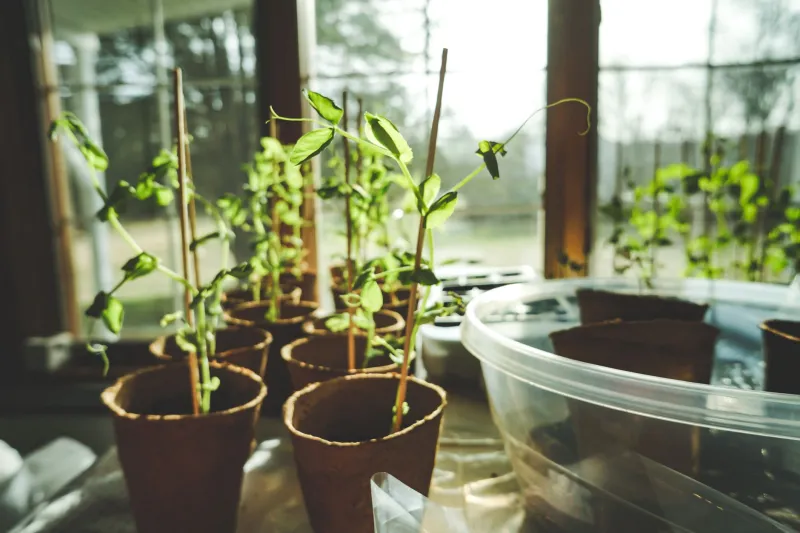
So the next time you notice a houseplant straining towards the window, or a foxglove leaning out of a shady verge into the open, consider what is happening inside those stems. Photoreceptors at the tip have registered the direction of the light. PIN transporters have been redeployed. Auxin is pooling on the shaded side, loosening cell walls, and quietly, inexorably, turning the whole organism towards the sun.
It is signalling at its most economical — and it is happening in every garden in the country.